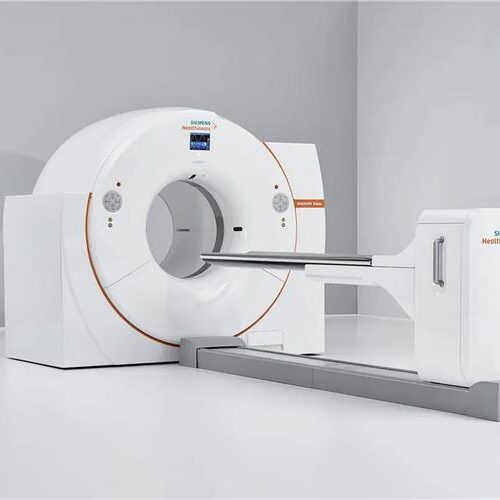
Advanced PET/CT Imaging
PET/CT combines the strengths of two different kinds of exams—the anatomical detail of CT with the diagnostic capability of PET—to deliver accurate answers to you and your patient.
What is a PET/CT scan?
A PET/CT scan uses an injected material called a glucose radiotracer to make metabolic processes visible to the PET scanner, often while also using other contrast material to support the CT scanner’s creation of detailed images of organs and tissues. It produces a detailed set of image “slices” that enable radiologists to see sections of organs, tissues, and their functional processes at different depths to diagnose various illnesses and conditions.
Your doctor may recommend a PET/CT scan when it’s necessary to combine highly detailed anatomical images with information about cellular and metabolic activity. This is particularly useful for detecting and monitoring cancer, as the PET component can reveal areas of high metabolic activity (often a sign of rapidly growing cancer cells) throughout the body, while the CT component provides precise anatomical location. Beyond cancer, a PET/CT can also be crucial for assessing the spread of disease, determining the effectiveness of treatments, and evaluating certain neurological conditions like Alzheimer’s disease or Parkinson’s, which are associated with changes in brain metabolism. The scan can also be used to investigate persistent fevers of unknown origin or evaluate the viability of heart tissue after a heart attack. Ultimately, a PET/CT is recommended when a combined view of the location and underlying activity of disease is essential for diagnosis and treatment planning.
On the exam day, patients should choose comfortable, loose-fitting clothing to make it easier to change into an examination gown and receive injections. Depending on certain factors such as the reason for the exam, age, or medical history, the referring physician may order additional preparation before the exam day. For example:
- If there is any possibility of pregnancy, or if a patient is currently breastfeeding, it is very important to inform Princeton Radiology about this.
- The technologist will explain the procedure and answer questions.
- When the patient is ready for the scan, we will test the patient’s blood sugar.
- Patients may receive an oral contrast
(barium drink). - We will start an IV and inject a small amount of safe, radioactive glucose (sugar). The sugar and contrast material help the scanner see internal tissues and processes.
- The patient will then be asked to wait very quietly in a seating area. Any activity, even talking or chewing gum, may distort the results.
- Just before the scan, the patient will be asked to empty their bladder. During the exam, the patient will lie on a bed that passes slowly through the scanner. It is important to lie quietly and remain still. Scanning should take about 45 minutes.
- Patients should plan to spend about two hours at our facility from arrival to dep
Benefits of PET/CT Imaging
PET/CT can detect abnormalities at an early stage, allowing for prompt intervention and improved outcomes.
By analyzing metabolic activity, PET/CT helps differentiate between benign and malignant lesions, guiding treatment decisions.
PET/CT enables real-time monitoring of treatment response, ensuring personalized and effective therapies.
From cancer staging to heart and brain imaging, PET/CT provides a comprehensive assessment of various conditions.
PET/CT With PYLARIFY®
Available to MEDICARE patients
With metastatic prostate cancer incidence on the rise according to the American Cancer Society, early detection is more important than ever. Princeton Radiology introduces PET/CT with PYLARIFY®, a powerful solution that was recently approved for coverage by the Centers for Medicare and Medicaid Services (CMS).
Benefits of PET/CT scan with PYLARIFY®:
- Accurately identifies sites of disease for newly diagnosed patients who are candidates for definitive treatment
- Identifies sites of metastatic disease in patients who have undergone definitive therapy but have rising PSA
- Detects metastases earlier and more accurately in lymph nodes, bone, and soft tissue than CT scanning or Bone Scan
- Supports informed treatment decisions and planning precisely targeted therapy

Over 60 years of excellence in imaging.
And that’s just one reason why Princeton Radiology is the right choice.
Interpretations by board certified, sub-specialty trained radiologists.
Fast scheduling, less time in the waiting room, and same-day or next-day results in most cases.
We cater to patient schedules with daytime, evening and weekend hours for many exams.
From our friendly and caring staff to our beautiful imaging facilities, everything we do is patient-focused.